Makar Sankranti Photo Prompt: 22 Gemini Ideas by Region
Each Makar Sankranti photo prompt here puts you in your own region's festival in Gemini or ChatGPT: a kite on an Ahmedabad terrace, a Pongal pot boiling over, Maharashtra's black clothes and sugar jewellery. All 22 keep your face unchanged. Sankranti 2027 is on 14 or 15 January, by calendar.

Makar Sankranti is one festival with six faces. In Ahmedabad it is a kite fight from the rooftops; in Tamil Nadu it is a clay pot of rice and milk boiling over at sunrise; in Pune a baby sits in black clothes and sugar jewellery while relatives shower her with puffed rice. A Makar Sankranti photo prompt that only says "festive photo" gets you none of that, because the app has to guess which Sankranti you mean.
So every Makar Sankranti photo prompt below is written for one region's way of celebrating, using customs we checked against published sources, and each ends with a line telling Gemini or ChatGPT not to touch your face. We wrote these prompts ourselves from Google's published prompting advice. We can't show you sample outputs and haven't run them on your photo, so expect to try two or three before one lands.
Makar Sankranti 2027 date, by region
The festival falls on 14 or 15 January 2027, and the answer depends on which calendar you follow. Drik Panchang's Makar Sankranti page (calculated for New Delhi) puts the Sun's move into Capricorn at 9:14 pm on Thursday 14 January, so it lists the festival on Friday 15 January 2027. The central government's restricted-holiday list for Delhi offices, in the Department of Personnel and Training's order of 16 July 2026 (copy circulated by India Post), lists "Makar Sankranti / Magha Bihu" on Thursday 14 January and Pongal on Friday 15 January.
The gap comes from the evening transit. Drik Panchang's rule moves the observance to the next morning when the Sun changes sign after sunset. If your family follows a local panchang or your state's holiday list, use that.
| Region | Festival name | 2027 date (Drik Panchang) | Prompts |
|---|---|---|---|
| Gujarat | Uttarayan | Fri 15 Jan | 1-4 |
| Tamil Nadu | Bhogi, Thai Pongal, Mattu Pongal | Thu 14, Fri 15, Sat 16 Jan | 5-8 |
| Maharashtra | Makar Sankranti (Sankrant) | Fri 15 Jan | 9-12 |
| Punjab | Lohri | Thu 14 Jan | 13-14 |
| Assam | Magh (Bhogali) Bihu | Fri 15 Jan | 15-17 |
| West Bengal | Poush Sankranti | Fri 15 Jan | 18-19 |
| Bihar, Uttar Pradesh | Khichdi, Dahi Chura | Fri 15 Jan | 20 |
Dates from Drik Panchang's January 2027 festival list, read 19 November 2026. The government list above gives 14 January for Sankranti and Magha Bihu.
By who is in the photo: couples 2, 7, 9, 13; women and girls 3, 5, 10, 16, 18; men and boys 1, 15, 21; babies and kids 8, 11, 12, 14; families and friends 4, 6, 17, 19, 20; a greeting card with your photo 22.
The line that ends every prompt
Each Makar Sankranti photo prompt here closes with one fixed instruction, adjusted for how many people are in the picture:
Keep this person's face and expression unchanged from the photo; alter only the clothes, setting and light.Google's developer guide to prompting its image model says features can "begin to drift after many iterative edits", so the safest habit is to say what must not change, every time. The same guide says "a narrative, descriptive paragraph will almost always produce a better, more coherent image than a simple list of disconnected words", which is why each prompt describes a whole scene.
Uttarayan prompts: kites on Ahmedabad's rooftops
Custom check: in Ahmedabad's old walled city, terraces in the pols (old neighbourhoods) are rented out for the day and decorated with balloons and garden umbrellas for kite flying, and the cry is "Kai po che", a PTI report from January 2026 says. Undhiyu, jalebi and chikki are the festival foods. Incredible India lists the International Kite Festival for 10-14 January 2027 at the Sabarmati Riverfront.
1. Man or boy: first kite of the morning
Place the person from the uploaded photo on a rooftop terrace in the old city of Ahmedabad on a bright January morning, launching a diamond-shaped paper kite, his arm raised and the string taut. The sky behind him is full of small colourful kites, and the neighbouring terraces of old pol houses are painted and hung with balloons. He wears a white kurta and a sleeveless jacket. Realistic photograph, crisp winter light. Keep this person's face and expression unchanged from the photo; alter only the clothes, setting and light.2. Couple: one holds the kite, one holds the spool
Show the two people from the uploaded photo together on a decorated Ahmedabad rooftop during Uttarayan. One flies a bright pink paper kite while the other holds the wooden spool of string, both laughing as the kite climbs. A garden umbrella shades a low table with plates of undhiyu and jalebi. Old city terraces and dozens of kites fill the background. Keep both people's faces and expressions unchanged from the photo; alter only the clothes, setting and light.3. Woman or girl: bandhani dupatta at the parapet
Show the person from the uploaded photo leaning on the parapet of an old Ahmedabad rooftop, holding a yellow and red paper kite, wearing a bandhani dupatta in red and yellow over a simple kurta. Wooden balconies of old pol houses behind her, the sky crowded with kites, soft late-morning sun on her face. Realistic festival portrait. Keep this person's face and expression unchanged from the photo; alter only the clothes, setting and light.4. Family: kites at dusk
Show the family from the uploaded photo on a rooftop terrace in Ahmedabad at dusk on Uttarayan, the children pointing at illuminated kites rising into an orange sky, a steel plate of sesame and peanut chikki on the ledge, string lights along the railing. Warm, candid family photograph. Keep every person's face and expression unchanged from the photo; alter only the clothes, setting and light.Pongal photo prompts: the pot, the kolam, the cattle
Custom check: on Thai Pongal, freshly harvested rice is boiled with milk and jaggery in a new clay pot, cooked at sunrise in the open, and allowed to boil over as a sign of plenty, Drik Panchang says. The pot is often tied with a turmeric plant and set out with sugarcane stalks, homes are decorated with rice-flour kolams, people wear new clothes, and on Mattu Pongal cattle are bathed and their horns painted, according to Wikipedia's Pongal article.
5. Woman or girl: kolam at dawn
Show the person from the uploaded photo crouched at the doorstep of a Tamil Nadu home at dawn, drawing a large white rice-flour kolam of dots, loops and curves, with a few touches of red and yellow colour. She wears a new silk saree in deep green with a gold border and jasmine in her hair. Mango leaves hang over the doorway. Soft early-morning light. Keep this person's face and expression unchanged from the photo; alter only the clothes, setting and light.6. Family: the moment the pot boils over
Show the family from the uploaded photo in an open courtyard in Tamil Nadu at sunrise on Thai Pongal, gathered around a new clay pot on a wood fire. A turmeric plant is tied around the pot's neck, white foam of rice and milk is spilling over its rim, tall sugarcane stalks lean beside it, and banana leaves are laid out on the ground. Everyone is cheering at the overflow. Everyone wears new festive clothes. Keep every person's face and expression unchanged from the photo; alter only the clothes, setting and light.7. Couple: veshti and silk saree
Show the two people from the uploaded photo standing beside an overflowing Pongal pot in a village courtyard at sunrise, one in a crisp white veshti and shirt with a gold border, the other in a bright silk saree, both holding a stalk of sugarcane and smiling at the camera. A rice-flour kolam is drawn on the ground in front of them. Keep both people's faces and expressions unchanged from the photo; alter only the clothes, setting and light.8. Kids: Mattu Pongal with a calf
Show the child from the uploaded photo in a Tamil Nadu village on Mattu Pongal, standing gently beside a calm calf whose horns are painted in bright colours and whose neck carries a marigold garland. The child wears new festive clothes. Morning light, a decorated cowshed softly blurred behind. Keep this child's face and expression unchanged from the photo; alter only the clothes, setting and light.Maharashtra prompts: black clothes, til-gul and sugar jewellery
Custom check: Maharashtra is the one place where black is the Sankranti colour. People exchange tilgul (sesame and jaggery sweets) with the greeting "Tilgul ghya, god god bola", meaning "take this tilgul and speak sweetly", and wearing black on the day is a regional custom, Wikipedia's Makar Sankranti article notes. Newlyweds in their first year wear black with halwyache dagine, jewellery made of sugar-coated sesame beads, The Better India reported. Babies and children up to five get bornahan: dressed in black with sugar jewellery, they are showered with puffed rice, small ber fruits, groundnut pods and carrot pieces, per Lokmat Times.
9. Couple: first Sankrant after the wedding
Show the two people from the uploaded photo as a newly married Maharashtrian couple on their first Makar Sankranti, seated on a low wooden bench in a home decorated with marigolds. She wears a black silk saree with a gold border and jewellery made of tiny white sugar-coated sesame beads: a necklace, earrings, a maang tikka and a waist belt. He wears a black kurta. A brass plate of tilgul laddoos sits between them. Warm indoor light. Keep both people's faces and expressions unchanged from the photo; alter only the clothes, setting and light.10. Woman or girl: offering tilgul
Show the person from the uploaded photo in a Pune home doorway on Makar Sankranti, wearing a black saree with a contrasting red border, holding out a small steel bowl of tilgul towards the camera with a warm smile. A rangoli with a sun motif is drawn on the floor at the threshold. Natural afternoon light. Keep this person's face and expression unchanged from the photo; alter only the clothes, setting and light.11. Baby girl: bornahan
Show the baby girl from the uploaded photo sitting on a soft mat during a Maharashtrian bornahan ceremony, wearing a tiny black ghagra-choli and jewellery made of white sugar-coated sesame beads: a necklace, bangles and anklets. Hands of relatives at the edge of the frame gently shower her with puffed rice and small ber fruits, with groundnut pods scattered around her. Bright, soft indoor light. Keep this baby's face and expression unchanged from the photo; alter only the clothes, setting and light.12. Baby boy: bornahan crown and flute
Show the baby boy from the uploaded photo during a Maharashtrian bornahan ceremony, wearing a small black kurta, a crown and a necklace made of white sugar-coated sesame beads, holding a little sugar-bead flute. Puffed rice and small ber fruits are falling around him, and other children are reaching in to pick them up. Cheerful, soft light. Keep this baby's face and expression unchanged from the photo; alter only the clothes, setting and light.Lohri prompts: the bonfire night before
Lohri gets far fewer searches than Sankranti or Pongal, so two prompts cover it. Custom check: families light a bonfire at sunset, toss sesame, jaggery, rewri, peanuts and popcorn into it, and sing and dance around it; homes with a new marriage or a newborn celebrate their first Lohri with extra excitement, Wikipedia's Lohri article says. Drik Panchang lists Lohri 2027 on Thursday 14 January.
13. Couple: first Lohri
Show the two people from the uploaded photo at a Lohri bonfire at night in a Punjabi village courtyard, tossing popcorn and rewri into the flames while relatives clap and sing around them. She wears a phulkari dupatta in orange and pink, he wears a kurta and a warm shawl. The firelight glows on their faces. Keep both people's faces and expressions unchanged from the photo; alter only the clothes, setting and light.14. Baby: first Lohri
Show the baby from the uploaded photo wrapped in a warm phulkari shawl, held up towards the camera at a family Lohri celebration, with a bonfire glowing softly far in the background and bowls of peanuts, gajak and popcorn on a table nearby. Warm, cosy evening light. Keep this baby's face and expression unchanged from the photo; alter only the clothes, setting and light.Magh Bihu prompts: Meji fires and Bhelaghar huts
Custom check: on Uruka, the eve of Magh Bihu, people feast around a bonfire; young people build huts of bamboo, leaves and thatch called Bhelaghar; and the day begins at dawn with the Meji bonfire, with pitha rice cakes and laru as the festival sweets, Wikipedia's Magh Bihu article says. These are for January's Magh Bihu, not the spring Bohag (Rongali) Bihu of April, which has its own dance, music and clothes. There is no Bihu photo prompt template or PDF to download: each prompt is plain text you copy into the app.
15. Man or boy: Meji at dawn
Show the person from the uploaded photo standing in a harvested paddy field in Assam at dawn on Magh Bihu, beside a tall Meji bonfire built of bamboo, hay and dried banana leaves, its flames rising into a misty pink sky. He wears a white dhoti and kurta with a red and white gamosa around his neck. Keep this person's face and expression unchanged from the photo; alter only the clothes, setting and light.16. Woman or girl: Uruka night feast
Show the person from the uploaded photo at an Uruka night feast in an Assamese village, wearing a cream mekhela chador with red woven motifs, carrying a brass plate of til pitha and coconut laru towards a crackling fire where friends are cooking. Warm firelight, starry winter sky. Keep this person's face and expression unchanged from the photo; alter only the clothes, setting and light.17. Friends: in front of the Bhelaghar
Show the group of friends from the uploaded photo sitting together in front of a Bhelaghar, a hut of bamboo, leaves and thatch built on a harvested field in Assam, sharing food around a small fire on Uruka night. Everyone wraps up in shawls, laughing. Keep every person's face and expression unchanged from the photo; alter only the clothes, setting and light.Poush Sankranti prompts: pithe in a Bengal kitchen
Custom check: in West Bengal the day is Poush Sankranti, when families make pithe, sweets of rice flour, coconut and milk sweetened with date-palm jaggery (khejurer gur and patali), according to Wikipedia's Makar Sankranti article.
18. Woman or girl with grandmother: making pithe
Show the person from the uploaded photo in a warm Kolkata kitchen on Poush Sankranti, sitting on the floor beside an older woman, both shaping rice-flour pithe filled with grated coconut and date-palm jaggery. A clay pot of liquid jaggery and a plate of finished pithe sit between them. She wears a red-bordered white cotton saree. Morning light through a window. Keep this person's face and expression unchanged from the photo; alter only the clothes, setting and light.19. Family: the pithe table
Show the family from the uploaded photo around a dining table on Poush Sankranti, sharing plates of pithe and blocks of patali gur, steam rising from cups of tea, everyone mid-laugh. A cosy Bengali home, warm winter light. Keep every person's face and expression unchanged from the photo; alter only the clothes, setting and light.Two more: Bihar's dahi-chura, a quick outfit swap and a card
In Bihar the day is known as Dahi Chura, and in Uttar Pradesh and Bihar it is also called Khichdi after the rice-and-lentil dish, Wikipedia's Makar Sankranti article notes.
20. Family: dahi-chura breakfast in Bihar
Show the family from the uploaded photo sitting on a mat in a sunny courtyard in Bihar on Makar Sankranti morning, eating bowls of flattened rice with curd, with a plate of til laddoos beside them. Everyone in warm winter clothes and shawls. Natural, candid photograph. Keep every person's face and expression unchanged from the photo; alter only the clothes, setting and light.21. Quick edit: just the black kurta
Use this when a full scene keeps changing your face. It asks for one change only.
Change only the shirt of the person in this photo into a black cotton kurta for Makar Sankranti. Keep this person's face and expression unchanged from the photo, and keep the hair, pose and background exactly as they are.22. A Sankranti card with your photo
Turn the uploaded photo into a Makar Sankranti greeting card. Keep the person in the centre, framed by colourful paper kites in the top corners and a border of til laddoos and sugarcane at the bottom, on a warm sunrise-orange background. Add the words "Happy Sankranti" in clean bold letters at the top. Keep this person's face and expression unchanged from the photo; alter only the clothes, setting and light.Short words come out cleaner than long ones, so check the spelling of "Happy Sankranti" before you post. For an Instagram post, you can add "vertical portrait format" to the end of any prompt; if the app ignores it, crop the result.
How to use a Makar Sankranti photo prompt in Gemini
These steps follow Google's help page on creating and editing images, read on 19 November 2026.
- Open the Gemini app or gemini.google.com and sign in. Google says: "To generate and edit images, you must be 18 or over."
- Pick the model. With the Gemini model set to Flash or Pro, Google says image requests go to Nano Banana 2, which "can accept multiple reference images". Flash-Lite uses Nano Banana Lite, which Google says "isn't designed for multiple image references or for multiple edits", so avoid it for face edits.
- Upload your photo in the chat box and paste one prompt from this page, with your own details changed if you like.
- Redo with Pro if you pay. On a Google AI plan, tap More, then Redo with Pro. Google says Nano Banana Pro adds detail, especially where an image has text, so use it for prompt 22's lettering. If you've hit your daily Nano Banana 2 quota, Redo with Pro won't work either.
- Save it. On a phone, touch and hold the image. On the web, hover over it and click Download full size.
Google doesn't publish a fixed number of free images a day; our guide to Gemini limits per day explains what each Google AI plan in India gets.
How to use it in ChatGPT
OpenAI's help pages blocked our reader on 19 November 2026, so these points come from the Images in ChatGPT help page as we read it on 18 November for our IPL AI photo prompt guide. It said ChatGPT Images "is available on all tiers", on web, iOS and Android.
- Upload your photo in a ChatGPT chat and paste the prompt.
- Edit one area at a time if the first result misses: open the image, choose Select, highlight only the clothes or the background, and describe the change. OpenAI warned that "edits may extend beyond the area you selected", so check the face afterwards.
- Save it from the image controls.
Photo tips before you upload
- One clear, front-facing photo in daylight or even indoor light works best. Skip beauty filters, sunglasses and caps that shade the eyes.
- Match the photo to the prompt. A couple prompt needs a photo of the two of you together; a single-person prompt with a group photo makes the app guess whose face to keep.
- Babies: use a photo where the baby's whole face is visible and in focus, not a side profile in a parent's arms.
- Name the setting and the light. Google's help page advises a "detailed visual description" of the subject, what they are doing and the background, which every prompt above already has.
What to do when the face changes
If the result shows a stranger, don't keep editing the same picture: drift builds with each edit, Google's developer guide says, and it suggests restarting a new conversation.
- Start a new chat and upload your original photo again, not the last result.
- Make one change first. Prompt 21 swaps only the shirt. Add the scene in a second request.
- Cut the crowd. Prompts with many people and objects give the model more to get wrong; delete the relatives and the food from the prompt and try again.
- In ChatGPT, use Select on the clothes or background only, so the face stays outside the edited area.
- Try the other app. Gemini and ChatGPT use different image models, and one may hold your face better for a given photo. Google describes its paid Nano Banana Pro model as having "higher consistency".
Our Christmas photo prompts and New Year prompts for Gemini use the same keep-your-face method if you want festive pictures for the weeks before Sankranti.
Uploading faces and children's photos: what Google says
Read this before you upload a photo of your child or of relatives. Google's Gemini privacy hub, read on 19 November 2026, says:
- Human reviewers read some chats, and chats they review "are retained for up to three years", even if you delete your history.
- Photos you share from a connected gallery app are used to improve Google services, with human reviewers, when your Gemini History setting is on.
- Temporary chats are not used to train Google's AI models; they and chats with History off are kept for around two months.
- Ask first: Google tells users to "get permission before … using their faces or voices in Gemini".
Our call: for a baby or child, use a temporary chat or switch History off first, and share the result in family groups rather than on a public profile. A bornahan photo is a lovely keepsake, and it doesn't need to be searchable.
The AI marks on your Sankranti photo
Gemini labels everything it makes, in ways you can and can't see.
| Mark | What it is | Gemini in India |
|---|---|---|
| Visible watermark | A small mark on the image | On every image, unless you have AI Ultra |
| SynthID | An invisible watermark | On all media Gemini creates or edits |
| Content Credentials (C2PA) | Metadata recording the image's origin | Included |
Sources: Google's watermark settings page and verification page, read 19 November 2026.
Google's watermark page says that in India the setting to switch off the visible watermark appears only with an AI Ultra subscription, and it doesn't affect SynthID or Content Credentials. To check a picture, upload it to Gemini and ask "Is this AI-generated?"; Google says Content Credentials checks work on gemini.google.com and the Android app, with iOS "soon". For ChatGPT, OpenAI's provenance page, as we read it on 18 November, said its images carry C2PA metadata. Saying "AI-edited" in your caption is the honest move; our guide on how to detect AI-generated images covers the checks others will run.
FAQ
What is the best Makar Sankranti photo prompt for Gemini?
One that describes your region's real scene, such as a kite on an Ahmedabad terrace or a Pongal pot boiling over at sunrise, and ends by telling Gemini to keep your face and expression unchanged. Google says a full descriptive paragraph works better than a list of keywords.
Is Makar Sankranti on 14 or 15 January 2027?
Drik Panchang lists Friday 15 January 2027, because the Sun enters Capricorn at 9:14 pm on 14 January. The central government's restricted-holiday list for Delhi offices gives Thursday 14 January, with Pongal on the 15th.
Can I make a Makar Sankranti AI photo of my baby girl or boy?
Yes, from a parent's account: Gemini requires users to be 18 or over to edit images. Prompts 11 and 12 recreate Maharashtra's bornahan, and 14 a baby's first Lohri. Use a temporary chat, because Google keeps human-reviewed chats for up to three years.
Why do people wear black on Makar Sankranti in Maharashtra?
Wearing black on Sankranti is a Maharashtrian custom, usually explained as keeping warm in winter. Newlyweds wear black with sugar-bead jewellery on their first Sankranti, and young children wear black for bornahan.
Is the Gemini Sankranti photo edit free?
Yes, Gemini edits photos on its free plan, within daily limits Google doesn't publish as a fixed number. ChatGPT Images was also available on every tier, according to OpenAI's help page as we read it on 18 November 2026.
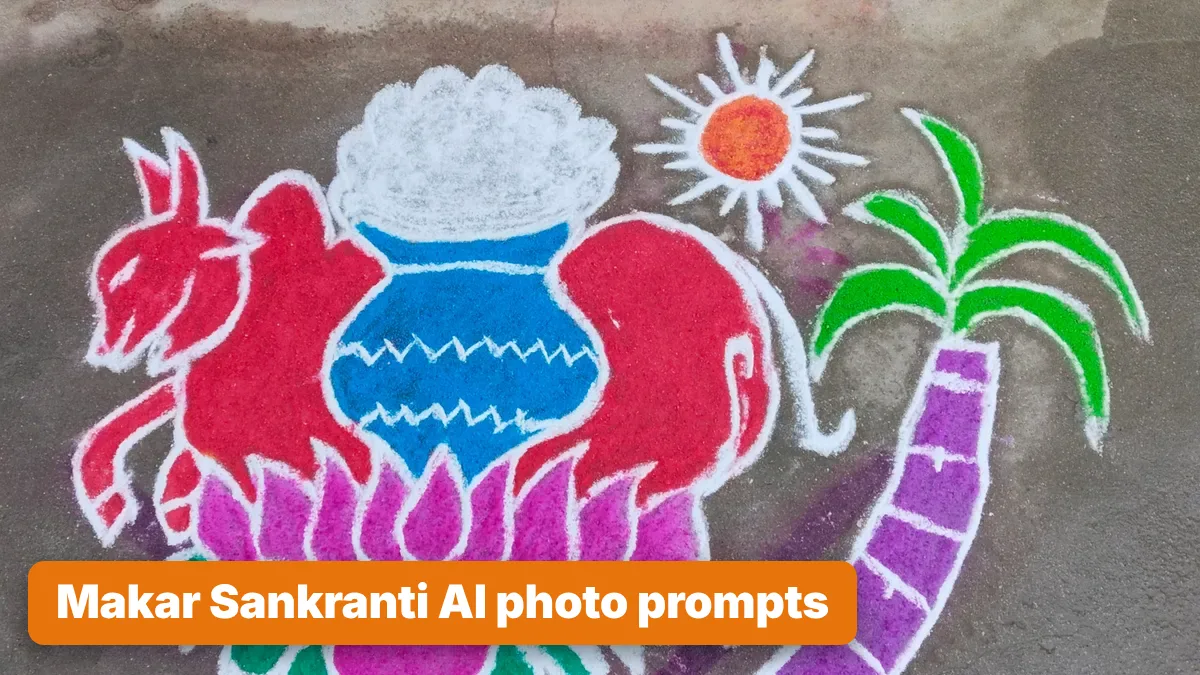
Cover image: a Pongal kolam of an overflowing pot between two bulls, with sugarcane and the sun, in coloured powder. Megala Shankar, CC BY-SA 4.0, via Wikimedia Commons.
Related tools
We may earn a commission if you buy through our links. This doesn't affect our rankings. Learn more about our affiliate disclosure.

Gemini
Google's multimodal AI assistant integrated across Search, Workspace, and Android.

ChatGPT
The most widely used AI chatbot for writing, coding, and research.
See more of BestAI.in in Google's Top Stories: add us as a preferred source.