Nvidia Chips to India and H-1B Fee: What Democrats Can't Change
Democrats won the US Congress, but Nvidia chips to India depend on the Commerce Department: a worldwide licence rule stays on the books, and it says it enforces that only for other countries. The $100,000 H-1B fee sits with the courts, and the 10% tariff with the White House.

Key points
- • US rules still require a licence for the top category of AI chips "to or within any destination worldwide", under [15 CFR 742.6](https://www.ecfr.gov/api/renderer/v1/content/enhanced/2026-11-03/title-15?chapter=VII&part=742§ion=742.6).
- • The one live chip fight could be settled by the outgoing Congress.
- • The $100,000 H-1B fee has not been removed; it has been blocked by two courts while the government appeals.
Almost nothing that decides AI chip supply, H-1B visas or US tariffs for India moved on 3 November, because Congress doesn't hold those levers.
Democrats won the House and Senate in the US midterms, and the new Congress sits in early January. The post-election reports we read focus on tariffs and visas. But the US rules themselves show something none of them mentions: Nvidia chips to India are not protected by any law. They flow because an American agency says it isn't enforcing a rule that is still on its books.
| Issue | Where it stands | Who decides | Can Congress change it? |
|---|---|---|---|
| Top AI chips | Licence rule on paper, not enforced for India on our reading | US Commerce Department | Only by passing a law |
| $100,000 H-1B fee | Blocked by two courts | Courts, then possibly the Supreme Court | Hearings and funding pressure |
| $103,265 H-1B fee | Proposed only | Department of Homeland Security | Oversight |
| 10% tariff | In force since 24 July | US Trade Representative | Only by passing a law |
| HIRE Act (outsourcing tax) | Bill, no progress | Congress | Yes, but no sign of movement |
Nvidia chips to India rest on a rule that isn't enforced
US rules still require a licence for the top category of AI chips "to or within any destination worldwide", under 15 CFR 742.6. The same text still prints a cap of 790,000,000 TPP, a computing-power measure, per country for 2025 to 2027. KPMG's Purushothaman KG told Business Today in February that this works out to "approximately 50,000 GPUs nationwide".
India is clear for now because the Bureau of Industry and Security (BIS) said in a 14 July rule that it "is only enforcing this license requirement" for certain country groups and for firms with parents in China or Macau. India is in none of those groups in the US tables. That India falls outside is our reading of the text, because BIS doesn't name India. An Indian unit of a China-headquartered group would still need a licence, on the same reading.
BIS promised a replacement rule in May 2025 and was aiming for 30 September this year, Export Compliance Daily reported. Our Federal Register check on 6 November found none. As we read it, Commerce could change India's position with no vote in Congress, and the February India-US statement promising more trade in GPUs is, as TechInsights' Manish Rawat put it, "policy stability, not a legally binding commitment".
This matters because Indian firms are buying at scale: Yotta announced 20,736 Nvidia Blackwell Ultra GPUs in February.
The chip vote may come before the new Congress sits
The one live chip fight could be settled by the outgoing Congress. Law firm Reed Smith expects a defence-bill compromise in the lame-duck session after Congress returns the week of 9 November, and one advocacy letter lists the Chip Security Act among Senate amendments. Whether it survives is unknown.
That bill is the one that reaches India. As introduced, it requires location verification on chips "before it is exported, reexported, or in-country transferred to or in a foreign country". Two other bills, GAIN AI and AI OVERWATCH, target countries of concern that don't include India, again as introduced; we haven't read the later committee versions.
Don't expect Democrats to be a brake. Three of the five Senate co-sponsors of GAIN AI are Democrats, including Chuck Schumer and Elizabeth Warren, and so are 18 of the 43 House co-sponsors of the Chip Security Act, by our count from the bill records.
The $100,000 H-1B fee sits with the courts
The $100,000 H-1B fee has not been removed; it has been blocked by two courts while the government appeals. "As of early November 2026, employers are not required to pay the $100,000 H-1B fee," Ahluwalia Law Offices wrote this week. But USCIS says: "If this order is later lifted, DHS still plans to collect the payment."
A second route is coming. DHS has proposed a $103,265 fee for cap-subject petitions, which could apply from the April 2027 season if finalised. Indians have the most at stake: those born in India took about 70% of approved H-1B petitions in fiscal 2025, IANS reported.
A Democratic House gets "subpoena power, hearings, and control over appropriations", IANS noted, "rather than a direct way to cancel the fee". We found no Democratic bill repealing it, and the party isn't united on H-1B. This is a summary, not legal advice.
The 10% tariff and the HIRE Act stay where they are
The tariff on Indian goods is 10%, under a US Trade Representative notice in force since 24 July. The 50% figure still seen in some reports is out of date. A separate law allows up to 100% on big buyers of Russian oil, but a 16 October order waives it with no end date, and it doesn't name India.
Analysts disagree on what comes next. "America's overall trade posture will remain intact," GTRI's Ajay Srivastava told Business Today. Economist Gita Gopinath's prediction was blunter: "Tariff policy will be less insane." The trade deal itself is unsigned, and PTI's sources say it wouldn't need Congress anyway.
"Hire act passed or not" is a common search here. It has not passed. The record for the bill, last updated on 19 August, shows no co-sponsors and no action since October 2025.
What it means for you
- Building on GPUs in India: plan for a rule that could change without warning, and read any BIS replacement closely when it lands.
- H-1B applicants and employers: the fee is paused, not dead. Watch the appeals and April 2027, and take advice from an immigration lawyer.
- ChatGPT and Gemini users: we found nothing linking this election to Indian prices or offers. Our AI subscription price guide tracks what you pay, and India's own AI rules don't depend on Washington.
For the US rules on AI itself, see our story on Trump's AI order.
Next dates: Congress returns the week of 9 November, US government funding expires on 11 December, and the H-1B cap season opens in April 2027.
Sources: 15 CFR 742.6; BIS rule, 14 July 2026; BIS on rescinding the Diffusion Rule; India-US Joint Statement, 6 February 2026; H.R. 3447, Chip Security Act; S. 3150, GAIN AI Act; DHS proposed fee rule; USTR tariff notice; Executive Order 14436; S. 2976, HIRE Act; PTI via Deccan Herald; Yotta's release.
How we reported this: we read the US regulations, Federal Register notices and bill texts above on 6 November 2026, and searched BIS's 2026 Federal Register documents by title for a replacement rule. Several large Indian news sites refused our requests, so "the coverage we read" means 11 post-election reports that loaded. We haven't seen any court order directly, or the committee versions of the chip bills. We could not confirm whether Yotta's cluster went live. We found no statement on the election from MEA, MeitY or Nasscom.
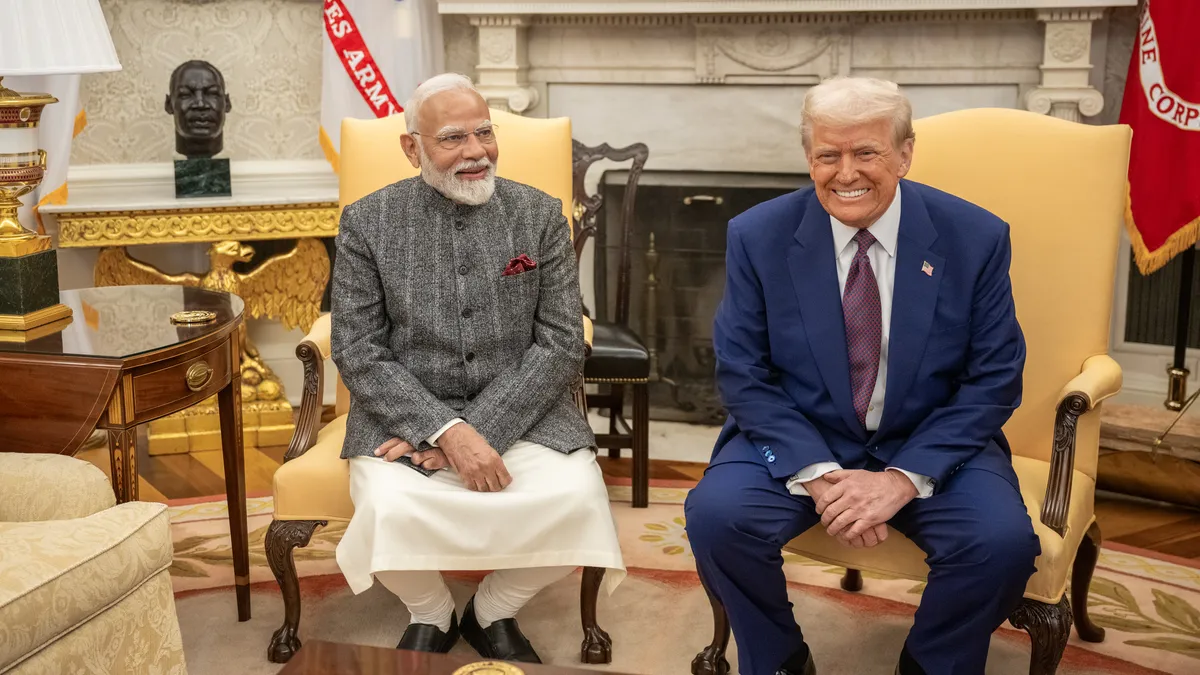
Cover image: file photo of Donald Trump and Narendra Modi in the Oval Office on 13 February 2025. The White House, Public domain, via Wikimedia Commons.
Source: https://www.federalregister.gov/documents/full_text/html/2026/07/14/2026-14132.html
Related tools
We may earn a commission if you buy through our links. This doesn't affect our rankings. Learn more about our affiliate disclosure.

ChatGPT
The most widely used AI chatbot for writing, coding, and research.

Gemini
Google's multimodal AI assistant integrated across Search, Workspace, and Android.
See more of BestAI.in in Google's Top Stories: add us as a preferred source.