US DeepSeek Ban: What It Covers, and the $15B Raise
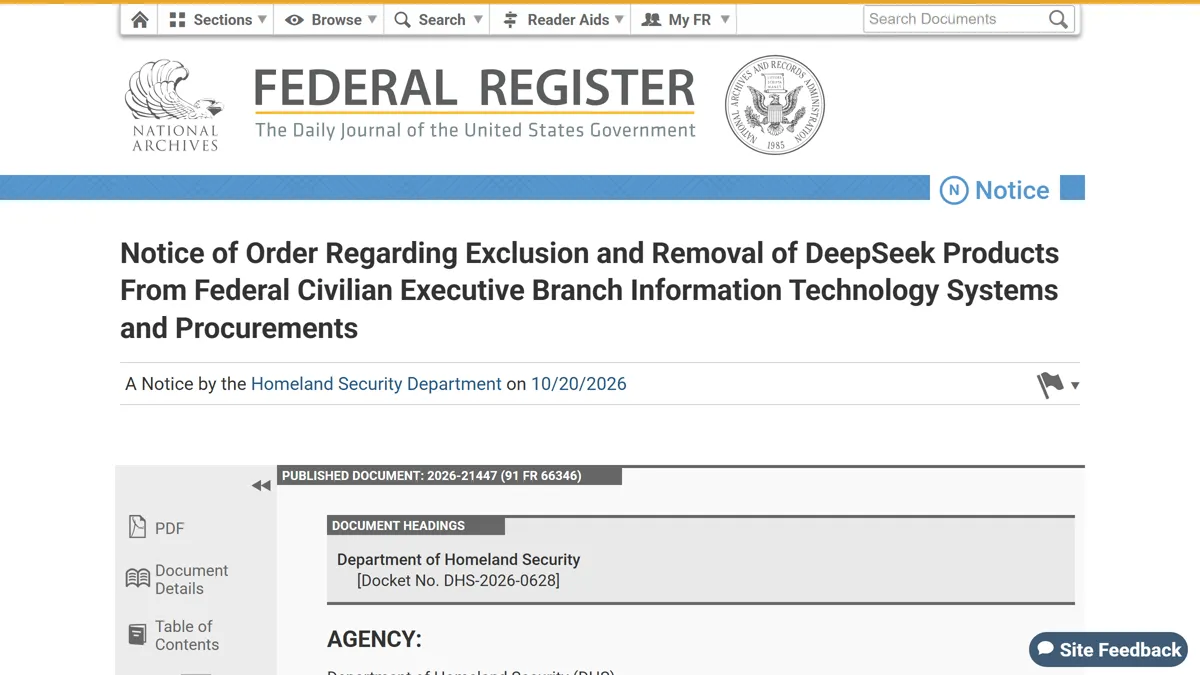
The US DeepSeek ban, published on 20 October 2026, orders federal civilian agencies to remove DeepSeek products, including third-party tools built on its technology, and stop buying them. It does not apply to companies or the public. Days later, Reuters reported a raise of about $15 billion.
Key points
- • According to The Hacker News, DHS Secretary Markwayne Mullin signed the order on 24 July 2026 under the Federal Acquisition Supply Chain Security Act, and it became public on 20 October.
- • Per BleepingComputer's reading of the notice, the reasons are the risk that the Chinese government could access DeepSeek's infrastructure and personal data, that sensitive government data could end up in China, and security weaknesses found in DeepSeek's iOS app by NowSecure in February 2025, including unencrypted data transmission and weak encryption.
- • The money moved the other way.
Two headlines about DeepSeek landed in the same week and pulled in opposite directions. Washington ordered its civilian agencies to rip DeepSeek out of their systems. Days later, investors led by Tencent and CATL were reported to be putting about $15 billion into the company. For anyone outside a US agency, including Indian developers who use DeepSeek's cheap API, the question is what the DeepSeek ban actually covers.
Key points
- The Department of Homeland Security's order, published in the Federal Register on 20 October 2026, bans federal civilian agencies from buying DeepSeek products and orders them removed.
- It reaches third-party products built on DeepSeek technology, without defining which. It is "not a general ban on private or consumer use," as BleepingComputer put it.
- Reuters, citing four sources, reported a round of about 100 billion yuan, roughly $15 billion, with more than 15 investors.
What the DeepSeek ban covers
According to The Hacker News, DHS Secretary Markwayne Mullin signed the order on 24 July 2026 under the Federal Acquisition Supply Chain Security Act, and it became public on 20 October. It names Hangzhou DeepSeek Artificial Intelligence Co. and its affiliates. Agencies must:
- Remove covered products from their IT systems, or seek an exception;
- Stop buying them, including through approved-product lists and marketplaces;
- Look inside other software, because products or services "developed using DeepSeek implementations" are covered too.
That last point is the hard one. The notice does not define "DeepSeek implementations," so an agency using a vendor's chatbot cannot easily tell whether a DeepSeek model sits underneath. Exception requests go to the Cybersecurity and Infrastructure Security Agency, which reviews them.
Why the US government acted
Per BleepingComputer's reading of the notice, the reasons are the risk that the Chinese government could access DeepSeek's infrastructure and personal data, that sensitive government data could end up in China, and security weaknesses found in DeepSeek's iOS app by NowSecure in February 2025, including unencrypted data transmission and weak encryption.
DeepSeek's $15 billion answer
The money moved the other way. Reuters reported that DeepSeek raised about 100 billion yuan from more than 15 investors, with CATL and Tencent among the largest and GigaDevice, Meituan and Geely also in, at a pre-money valuation of about 500 billion yuan. The company raised its target at least twice, from 50 billion yuan. Not every report agrees the round has formally closed, and DeepSeek has hired CITIC Securities for a possible Shanghai listing, per earlier reporting by CNBC.
That is a company whose API went down for nearly five hours on 15 October and refunded a week of usage, as our report on the DeepSeek outage explains. Its investors are betting on price and scale, not on Western government customers.
What the DeepSeek ban means in India
Nothing changes for Indian users directly: the order binds US federal civilian agencies only. India has its own, narrower precedent. In January 2025 the finance ministry told its employees to avoid AI tools including ChatGPT and DeepSeek on office devices over data confidentiality, Reuters reported at the time.
For Indian businesses, the useful lesson is about data, not geography:
- Know where prompts go. DeepSeek's hosted API processes data on its servers. Check your contracts and the data you send.
- Open weights are a different case. DeepSeek's open-weight models can run on your own hardware, so no data leaves your servers, much as Meta's Muse Spark Open can.
- Keep a second provider. The outage and the ban both argue for an API fallback such as Claude or ChatGPT.
FAQ
Is DeepSeek banned in the US?
Only for federal civilian agencies. The DHS order published on 20 October 2026 bans them from buying and using DeepSeek products. It does not ban companies or the public.
Is DeepSeek banned in India?
No. India has no general DeepSeek ban. Its finance ministry told employees in January 2025 to avoid AI tools including ChatGPT and DeepSeek on office devices.
Why did the US ban DeepSeek?
The notice cites the risk of Chinese government access to DeepSeek's infrastructure and user data, possible transfer of government data to China, and security flaws found in DeepSeek's iOS app.
Does the DeepSeek ban cover apps built on DeepSeek?
For federal agencies, yes. Products and services "developed using DeepSeek implementations" are covered, although the notice does not define the term.
How much did DeepSeek raise?
About 100 billion yuan, roughly $15 billion, per Reuters' sources, at a pre-money valuation of about 500 billion yuan. Some reports say the round is still being finalised.
Cover image: federalregister.gov, 31 Oct 2026.
Related tools
We may earn a commission if you buy through our links. This doesn't affect our rankings. Learn more about our affiliate disclosure.

ChatGPT
The most widely used AI chatbot for writing, coding, and research.

Claude
Anthropic's AI assistant known for careful reasoning and long context.

Gemini
Google's multimodal AI assistant integrated across Search, Workspace, and Android.
See more of BestAI.in in Google's Top Stories: add us as a preferred source.